

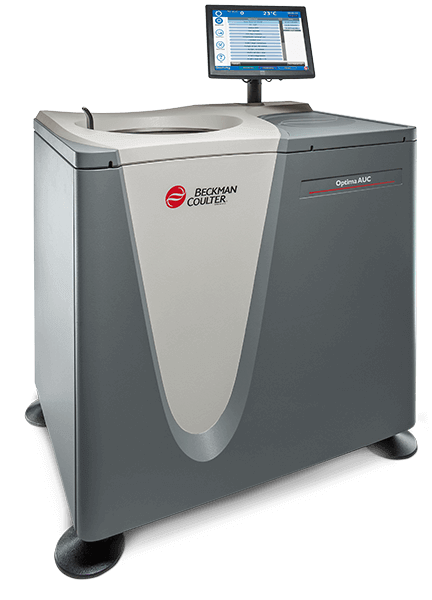
分析型超高速離心機
溶液中的大分子表徵
Analytical ultracentrifugation is the most versatile, rigorous and accurate means for determining the molecular weight, hydrodynamic and thermodynamic properties of a protein or other macromolecule. Currently, there is no other technique capable of providing the same range of information with a comparable level of precision and accuracy.
Want to learn more about Analytical Ultracentrifugation?
- Get an in-depth view into AUC with our Resources Section.
- Gain valuable insights into the advantages of AUC with these on-demand webinars.
FAQ on Analytical Ultracentrifuges
What is the difference between analytical and preparative ultracentrifugation?
Preparative ultracentrifugation is primarily used to separate and isolate particles for collection, while analytical ultracentrifugation is used to characterize and measure molecular properties. Analytical systems provide quantitative information about molecular weight, sedimentation behavior, aggregation, and sample heterogeneity.
What is analytical ultracentrifugation?
Analytical ultracentrifugation (AUC) is a solution-based analytical technique that uses high centrifugal forces to study the physical properties of macromolecules and particles. Researchers use AUC to determine molecular weight, size distribution, shape, aggregation state, and molecular interactions without the need for labels or reference standards.
What are the applications of analytical ultracentrifugation?
Analytical ultracentrifugation is widely used in biopharmaceutical development, protein analysis, antibody characterization, viral vector research, nanoparticle studies, and formulation development. It is particularly valuable for studying biomolecules under conditions that closely resemble their native environment.
How does analytical ultracentrifugation work?
Analytical ultracentrifugation works by spinning samples at very high speeds and monitoring how molecules move through a solution. The rate of sedimentation is measured using optical detection systems, allowing researchers to characterize molecular size, shape, concentration, and interaction behavior with high precision.
