
淘洗轉子
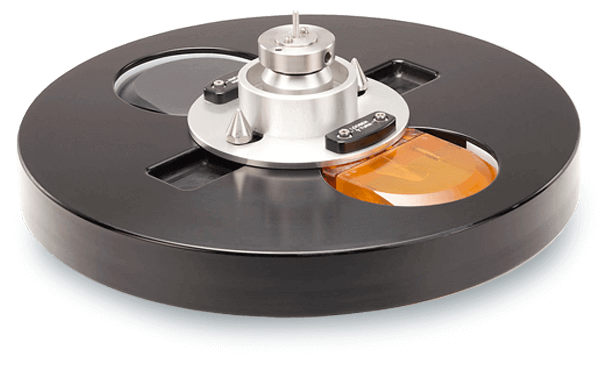
淘洗轉子適用於根據大小分離及/或濃縮單細胞或顆粒的單一散度懸浮液(直徑約為 2 至 50 µm)。淘洗轉子結合了兩種分離技術,並有兩種相對的力量作用於轉子艙室中的每個槽孔:
- 離心力:推離旋轉軸心。這是在離心力場的影響下的沉降程序。
- 液體速度:拉近旋轉軸心 —“逆流淘洗”。這是借由洗脫方式進行的分離程序。
分離發生於漏斗狀的淘洗艙室。當轉子在離心機中旋轉時,細胞懸浮液按預設的流速自離心機外部泵入轉子中進入淘洗艙室的狹窄末端。隨著懸浮細胞導入艙室,這些細胞按其沉降速率移動至兩種力量對這些細胞所產生效應達成平衡的梯度位置。
低沉降速率的小細胞被快速向旋轉軸心洗出。這些細胞被洗出艙室之外,沿著轉子上升,然後離開轉子進入收集管。較大或較密集的細胞較慢移動離開艙室,並且在淘洗邊界達成平行。最大或最密集的細胞留在艙室的進口,此處離心力與液體速度是高的。借由逐步增加流速,大小或密集度遞增的細胞連續組分可被洗出轉子之外並且被收集。持續遞增的流速最終會將所有細胞自艙室中洗出。
FAQ on Elutriation Rotors
How does an elutriation rotor work?
An elutriation rotor contains a specialized chamber in which cells are exposed to opposing centrifugal and fluid-flow forces. Smaller cells are carried out of the chamber more readily, while larger or denser cells remain until flow conditions change. This enables sequential collection of distinct cell populations.
What is counterflow centrifugal elutriation?
Counterflow centrifugal elutriation is a separation method in which fluid is pumped toward the center of a spinning rotor while centrifugal force drives particles outward. The balance between these opposing forces allows cells to be separated according to size and sedimentation behavior.
How are cells separated during centrifugal elutriation?
During centrifugal elutriation, cells are exposed to two opposing forces: centrifugal force, which drives cells away from the axis of rotation, and fluid flow, which pushes them in the opposite direction. Cells separate according to their size and sedimentation behavior. Smaller cells are elutriated first, while larger or denser cells remain in the chamber until higher flow rates are applied.
What is elutriation?
Elutriation is a separation technique that uses opposing fluid flow and centrifugal force to separate particles or cells according to their size and sedimentation properties. Unlike pelleting-based methods, elutriation enables continuous fractionation of cell populations while helping maintain cell viability.
What is centrifugal elutriation?
Centrifugal elutriation is a laboratory technique that combines centrifugation and controlled fluid flow within an elutriation chamber. Cells or particles separate based on their size and sedimentation rate as fluid moves against the centrifugal field.
What applications are elutriation rotors commonly used for?
Elutriation rotors are commonly used for cell fractionation, immune cell isolation, stem cell research, cell enrichment, cell therapy development, and other applications requiring gentle separation of viable cells.
What is the difference between elutriation and conventional centrifugation?
Conventional centrifugation typically separates particles by pelleting them within a tube. Elutriation separates cells continuously using opposing fluid flow and centrifugal force, enabling collection of distinct populations while minimizing cell stress and supporting higher cell viability.
What are the advantages of centrifugal elutriation?
Centrifugal elutriation can support gentle cell processing, high recovery rates, scalable workflows, and reproducible fractionation of cell populations. It is commonly used when viable cells must be isolated without labeling or extensive sample manipulation.
Why is elutriation used for cell separation?
Elutriation enables label-free separation of viable cells based on physical properties such as size and sedimentation rate. This makes it useful for applications where maintaining cell integrity and functionality is important.
